

From The Raptor Center
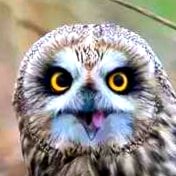
This fierce-looking young raptor is a baby great horned owl displaying its natural defensive behaviors when sensing a potential threat. These photos were taken upon this 4-week-old chick’s admission to TRC’s raptor hospital on March 29 after falling from its nest. The owlet’s puffed feathers and fanned-out tail are meant to make this baby look big and intimidating. A young owl in a defensive pose like this will also be snapping its beak together to make a “clacking” sound. That and the intense stare are warning signs designed to tell predators “Stay away!”
These feisty behaviors are healthy ones we like to see. While young patients remain in care at TRC’s raptor hospital, we follow practices to ensure they don’t habituate to or imprint on people. In wildlife, habituation occurs most readily in young animals when they get accustomed to human presence and lose their natural fear. Imprinting refers to the formation of an animal’s self-identity, typically through bonding with its parents, who provide food and care. It is important to prevent young patients from associating humans with parental roles. This would render them unfit to survive in the wild, as they would rely on humans rather than their own species to develop essential survival skills and would not properly interact with members of their own species.
Some of the ways we minimize their bonding with us are: feeding birds in the dark with sound machines so they don’t associate humans with food, wearing camouflage ghillie suits while feeding babies, encouraging them to self-feed as soon as possible, refraining from talking in baby areas so they don’t become used to human voices, and otherwise minimizing interactions with us.
So when our raptor patients make it clear they’d rather not be in our company, we’re glad, as it’s an encouraging sign in their journey to be released back to the wild.
After being medically cleared, this young owl, patient 25-0131, was successfully returned to the nest and its awaiting parents the following day.
I can see that these birds must have inherited something from T-Rex or common ancestors.
It lacks the teeth, but I had one of these snapping at my hand the other day while I was trying to feed him, and it felt like it may as well have been a baby dino.
We’re incredibly lucky that they are as small as they are. I’ve heard that crows can remember you very well, and if you mistreat a one, you’re going to pay for it later.
Imagine if that happened with a creature bigger than an elephant and about as ferocious as an owl. That’s not a minor inconvenience any more. One day, you’ll realise your car has been torn to shreds and your house has lost its ceiling and two walls. The deep footprints on the lawn tell you exactly who you pissed off 17 years ago.
The regular owls and things like herons can be intimidating as they are now. Things like the stilt owls or the Giant Cuban Owl would be on a whole other level!
The crow experiments are always fun to read about and must have been fun to be a part of. Feeding the crows is one of my favorite jobs. They are so social and are bursting with personality.
Owls are the most beautiful to me, but almost every other bird is more fun to actually work with. They are always very clear they have zero interest in us and just want to be solitary animals. A lot of the hawks will be interested in me, despite me making them nervous as a human, and the corvids seem to understand we’re bringing them prime grub and present no danger, and aren’t afraid to be themselves around me. They’re all fabulous in their own ways, and I’m glad I’m getting to know them all. I want to get some hands on time with vultures as well, but the opportunity hasn’t presented itself yet.
Oh wow. That’s just incredibly fascinating. How did you get a job like that?
I’ve heard that corvids in general are really smart and resourceful birds. Do you think they could have ended up becoming the dominant life form if humans never developed?
I just asked and they said yes! 😜
After posting here every day for 2 years, I wanted hands on knowledge and signed up to volunteer at the local wildlife clinic. We didn’t need any experience, we just had to pass a quick background check saying we aren’t creepers since we have kids for summer camps and other events. Everyone starts off feeding baby squirrels, and then you get to do other things, and if you have a particular interest, they can usually accommodate you. This is my second year doing it, and I am squirrel supervisor (basically training the noobs) and they’re having me run 2 booths (owls, naturally, and animal homes/nesting boxes) at our open house event this month. I was supposed to get to do live demos with our owls, but they both passed over the winter. 😢
To substitute I made life sized replicas of all 8 owls of our state, and I’ve also got plushes of the 2 most common owls we have, and last night stuffed them with beans, so now guests can hold a fairly scientifically accurate owl since they couldn’t actually touch our owls if we had any.
If you like animals, see if you can volunteer sometime. Most places have you do a shift around 4 hours once a week from Apr-Sep. You get to meet lots of great animals and kind hearted people too!