• 0 Posts
  • 18 Comments
Joined 8 months ago
cake
Cake day: March 17th, 2026

help-circle

  • lmmarsano@fedinsfw.apptopolitics @lemmy.world•Bad news for kinky Brits
    link
    fedilink
    English
    arrow-up
    1
    arrow-down
    1
    ·
    edit-2
    6 hours ago

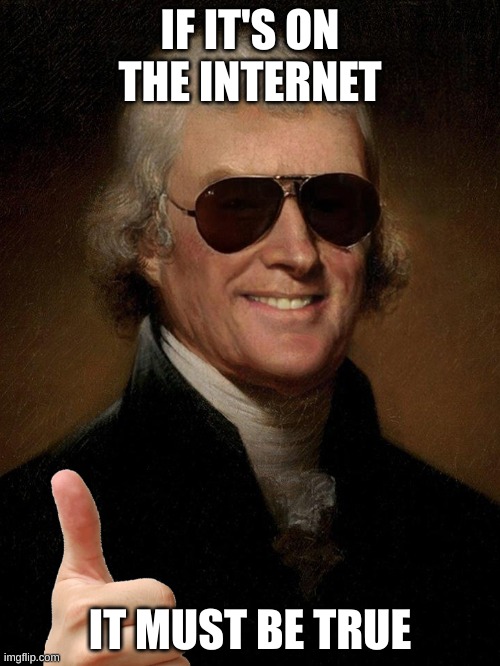
    meme of Thomas Jefferson in sunglasses gesturing thumbs up: if it's on the internet it must be true

    Lemmy’s a slur now, lemmings: it means something so monumentally stupid, it’s practically lemmy. Someone on lemmy said it, so it’s true! Now lemmy needs to change the name. Them’s the rules.

    The lack of sense on here to go along with whatever anyone says is incredible: it’s peak lemmy. Someone states a dumb opinion, then all the lemmings agree without question like it’s the undisputed truth.

    There’s a word to describe such profound lack of sense. When someone, their choices, or a state of affairs lacks sense or achieves significant stupidity, we call that stupid. That’s not a slur, that’s a judgement that plainly describes.



  • For the record, I’m not making a free speech absolutist argument.

    That’s a really strange disclaimer over a fundamental right akin to

    I’m not a self-determination absolutist

    I’m not a due-process-of-law absolutist

    I’m not a freedom-of-movement absolutist

    I’m not a freedom-of-conscience absolutist

    I’m not a warranted-search-and-seizure absolutist

    Absolutism here isn’t mentioned to disclaim protection of illegal speech, because that’s already unprotected, and no one here would dispute that. In this context, absolutism disclaims protection of unpopular speech people here would denounce, so it disclaims freedom of speech entirely.

    This denies the presumption of a fundamental right as protected, which is entirely backward. Fundamental rights are presumed protected, whereas attempts to restrict or challenge them need strict scrutiny. The less common disclaimer

    I’m not a censorship absolutist

    is an asymmetry revealing a copout.

    As for regulation, it’s a private device people are free to denounce, customize, or reject for a competitor. People have the liberty to produce & choose censored junk. An open society doesn’t restrict such choices when it can leverage fundamental rights[1] to denounce, criticize, and challenge.


    1. this community seems to cower from defending ↩︎


  • While I would love that, the more moderate republicans who argued to impeach & convict Trump last time were ousted, so that leaves the Trumpiest core to work with. GOP shittiness & general hostility to the government working in any sense for the American people can’t be underestimated. Plus, convicting Trump results in Vance replacing him.

    I think some highly guarded optimism is warranted. Blocking hideous legislation and Trump appointments isn’t too bad of a check if they’re unable to pull off anything better.


  • See? No serious alternative.

    What part of what you wrote contradicts anything written about democracy? The destruction & abuses you list could be far worse in governments with unchecked power.

    Democracy isn’t a magic salve that instantly cures everything it touches. Liberal democratic institutions permit reforms through a nonviolent, deliberative process to address everything you stated. To check abuses of power that could end democratic, open society, they also limit government capacity to unilaterally impose swift, sweeping changes. The institution trades sweeping state power that’s riskier to abuse for more limited, checked, deliberative state power likelier to sustain the democratic system. You don’t get democratic reforms without that slow, power-constrained work to protect the system.

    All that money the obscenely wealthy dumped into the elections didn’t get the results they paid for. Lack of action according to your timetable isn’t legal immunity.

    While your criticism gripes about the problems we can observe, no one is discounting them. We are criticizing your failures to consider all the problems we can’t observe (because the system of limited government avoided them) and the strength of nonviolent, popular reform.

    Your criticism looks like just griping that doesn’t seriously weigh the tradeoffs, which is fine to commiserate, but not a rational basis to weigh alternative systems of government.


  • A democracy can change those rules & technicalities, it just takes time & popular will.

    As argued by the same person who articulated the paradox of tolerance (widely distorted on social media), an overlooked strength of liberal democracy is the institutional framework (driven by competitive choices of the people open to rational debate) to institute reform without violence. To check abuses of power by the state, the people need to sustain such institutions that allow for open inquiry and grant all citizens extensive rights against their governments. They argued that strict limits on the power of the state limit bad or incompetent rulers from doing too much damage (eg, damage that outright ends a democratic, open society). Those limits on government with Democrats in legislative power are also why MAGA control of the legislature and executive hasn’t yet prevented elections and we don’t have to fight frequent revolutions to take back control.

    Democracy can reform itself nonviolently, presidents can be prosecuted when they leave office, and you’re not suggesting a serious alternative, just grief lacking nuance.


  • Many academics have vocally disagreed with Haidt’s conclusion that social media can be directly linked to declines in teens’ mental health. Haidt’s former colleague Peter Gray, a psychology research professor at Boston College, recently published a book criticizing Haidt’s theory as promoting a moral panic and offered an alternative theory that pins adolescent mental health issues to the rise of a stringent education curriculum under Common Core. Other prominent researchers also have critiqued the theory, and several large studies and meta analyses have found little or no direct effect of social media use on teen mental health at the population level.

    Still, Haidt’s theory has gained credence with many parents, teachers, and teens who believe it reflects their experience with social media.


  • Kind of wild how it’s always radio silence from the “Vote Blue No Matter Who” brigade in comment sections like this, where you have a centrist Dem using their platform to bash a progressive or leftist candidate just a couple days prior to elections

    Starting from a counterfactual isn’t a strong argument. El-Sayed won the primary for a reason and gets massive support in similar comment sections from Democrats overwhelmingly agreeing that Stevens can go fuck herself.

    How you divine who is & isn’t “the Vote Blue No Matter Who brigade” is the real mystery. Supporting commentary looks the same no matter who writes it, and it’s hardly needed when an upvote will do. Are you a mindreader? Do you consort with a higher power? Please show us your mystical, sagely ways.

    It’s especially comical because Vote Blue No Matter Who unsurprisingly means doing that regardless of whom blue is. It doesn’t necessarily imply broadcasting commentary everywhere about it to your satisfaction.

    It seems you’re agitating for some poorly articulated conflict in your deluded fantasy when the “Blue No Matter Who” crowd is embracing your candidate.


  • Anytime someone brings up paradox of intolerance in the fediverse, the chance is very high they’re completely wrong about it and are regurgitating shit they read from some dumbass on social media.

    1. The paradox of intolerance is a paradox, not a conclusion.
    2. The reductive conclusion social media dumbasses insinuate by invoking it is entirely wrong according to the philosopher who articulated the paradox.
    3. Intolerant carries a more technical meaning in philosophy (at least to that philosopher) than a mere disagreement with other ways: it includes the element of imposing (by unjustified force) on society to literally prohibit other ways. People who do not force us to comply with their position are tolerant.

    From the article (you didn’t read or understand) quoting Karl Popper (extended with the rest of the passage)

    [Less well known is the paradox of tolerance: Unlimited tolerance must lead to the disappearance of tolerance. If we extend unlimited tolerance even to those who are intolerant, if we are not prepared to defend a tolerant society against the onslaught of the intolerant, then the tolerant will be destroyed, and tolerance with them.—In this formulation, I do not imply, for instance, that we should always suppress the utterance of intolerant philosophies; as long as we can counter them by rational argument and keep them in check by public opinion, suppression would certainly be most unwise.] But we should claim the right to suppress them [intolerant ideologies] if necessary even by force; for it may easily turn out that they are not prepared to meet us on the level of rational argument, but begin by denouncing all argument; they may forbid their followers to listen to rational argument, because it is deceptive, and teach them to answer arguments by the use of their fists or pistols.

    The type of intolerance they refer to is the kind that uses force and refuses debate. They even explicitly reject that we should in general “suppress the utterance of intolerant philosophies” as long as rational argument & public opinion still govern public choice.

    background: book promotes intellectual freedom

    The quote comes from a footnote in the book The Open Society and Its Enemies, whose thesis is that an open society (ie, liberalism) has stronger merits than the newer, trendier totalitarian political theories of the day predicated on teleological historicism. They approached this from their background in philosophy of science (emphasizing enterprises controlled by skepticism and free inquiry) to argue that liberal democracies are not inevitably doomed by totalitarian systems of power, because liberal institutions have an overlooked strength

    Only democracy allows an institutional framework that permits reform without violence, and so the use of reason in political matters

    and to keep totalitarian systems like fascism or communism at bay, we need to sustain institutions that allow for open inquiry and grant all citizens extensive rights against their governments.

    Even with the best rulers, unchecked power is likely to err and cause unbound damage. Instead of focusing only on selecting the best rulers, a better system of government might determine

    How can we so organize political institutions that bad or incompetent rulers can be prevented from doing too much damage?

    They resolved that such a system should include strict limits on the power of the state and a special emphasis on intellectual freedom.

    They were absolutely arguing in favor of more open discourse & deliberation, not less of it, to reform government without violence and restrict its potential damage. That means tolerating opinions we disagree with from people who don’t try to impose them with force.

    Their discussion on public policy has no bearing on the democratic consequences accepting code that “solves the problem” from people we disagree with. It’s pretty much accepting charity and doesn’t imply you promote or agree with their views at all. Philosophers generally scoff at purity policing bullshit and genetic fallacies, especially those who emphasize free, open inquiry and rational argument as crucial to an open society.


  • Nice.

    I would be happy to add your links

    There are probably better ones. As a web developer, you may know a few.

    The technical guidelines are the most general covering every situation & technology including those unlikely here. We’re most likely dealing with Situation B in those guidelines

    Situation B: If a short description can not serve the same purpose and present the same information as the non-text content (e.g., a chart or diagram)

    It states that following technique

    G95: Providing short text alternatives that provide a brief description of the non-text content

    plus an additional technique including any of

    • G73: Providing a long description in another location with a link to it that is immediately adjacent to the non-text content
    • G74: Providing a long description in text near the non-text content, with a reference to the location of the long description in the short description

    suffices. In practice, that suggests (in order of practicality to minimize effort)

    1. If a web accessible alternative exists (eg, the image came from a web accessible web page), then set the post’s URL field to its location and set the post’s alt text field to “comic as described in link”.

    2. Otherwise, set the post’s alt text field to “comic as described in post body”, and set the post’s body field to a text alternative. The poster will probably have to transcribe the comic. Text recognition technology may assist in that task.

      If the text alternative is short, though, then setting the alt text field to the entire text alternative suffices as described in technique H37.