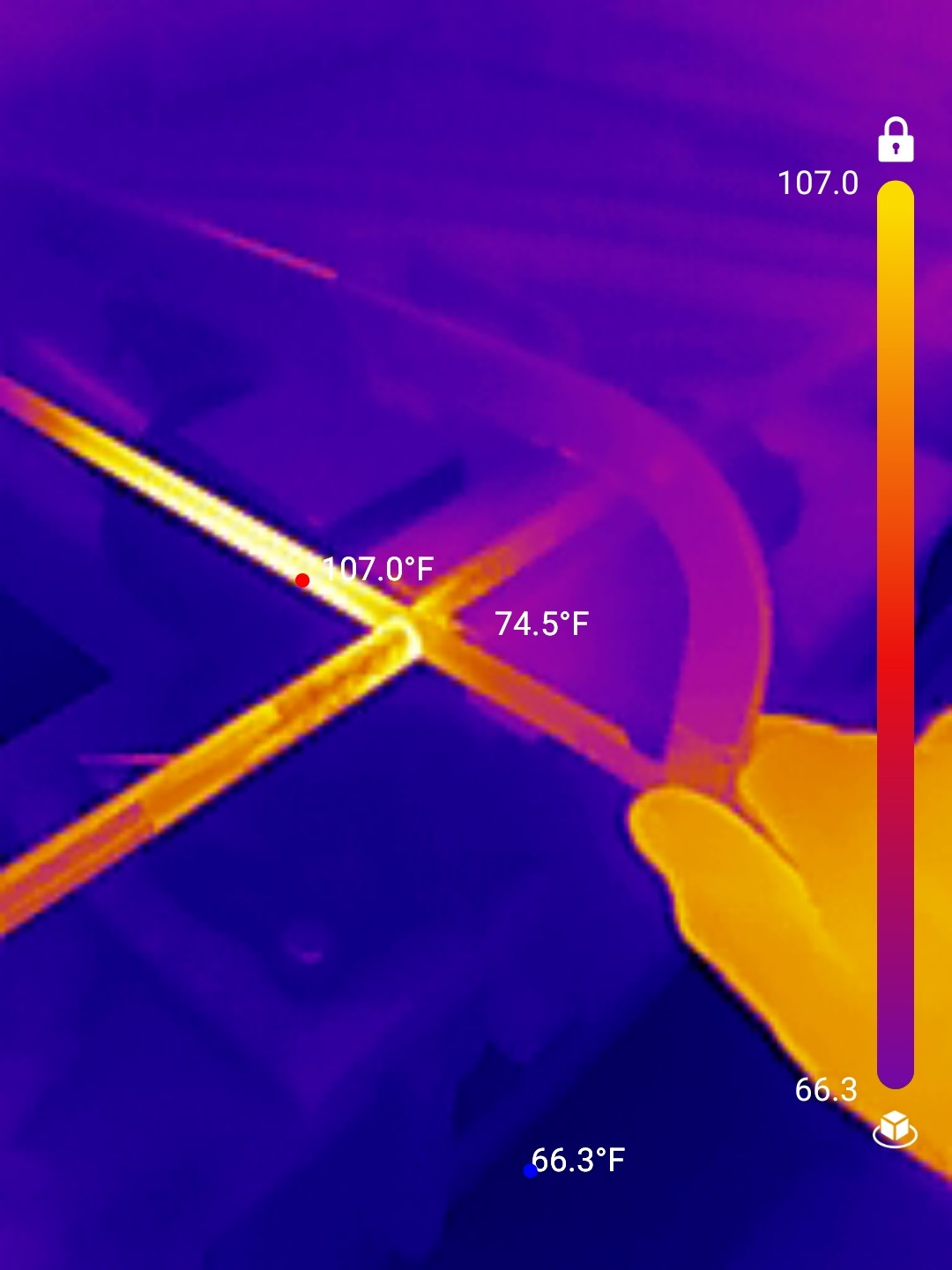
The bar is clamped in a metal vise, so the vise is very slightly heated and that side of the bar is much cooler.
Taken using the Topdon Android attachment.
I just finished cutting some 1/8" aluminum panels with an angle grinder and can attest to how hot metal gets when cutting. I kept forgetting where would be hot and got a nice burn across my arm to show for it.
Ouch, hope it mends fast.
Metal is pretty reflective in IR range, so you’re mostly measuring the room temp. You could fiddle with the emissivity settings, but the best way I’ve learned to measure reflective objects is small pieces of kapton tape. Highly emissive and doesn’t greatly change the thermals, so you can trust the measurement much more. That 100F temp might be closer to 300F for all we know.
The fact that this comment exists, and that it’s the top votes, is why I’m on Lemmy.
Nice tip! When I buy a thermal cam, I’ll put in an order kapton tape too.
I do have some kapton tape. I’ve heard black sharpie on masking tape too. The cutoff piece was definitely uncomfortable to hold but not in the range of instant burns; also a pretty dull surface. I wouldn’t be surprised if it were a bit about 107⁰F but I don’t think it was near 300⁰F.
Haven’t used sharpie and masking tape before, but I’ve used kapton at relatively high temps (500F). Contact pain for metal typically starts around 113F (45C), but I was referring to right where you were cutting, not where you were holding.
Once I used an oscillating multi-tool to saw a 1x2 wall stud that had water damage. It hit a nail and sparked a bit, then started to smoke, and then ignited the sawdust with a little flame shooting out from the cut.
Be careful not to let the fire out of the board
If the magic smoke escapes it won’t be able to power your lights anymore
I find this, mildly interesting…but really, is that why the hacksaws have the arched support instead of a single blade like other saws?
deleted by creator
I assumed it was because the blades wear quickly, but I wonder if it affects great dissipation too.
Does this also affect bandsaws, with a single, thin blade that moves rapidly? Your assumption was always mine until I saw this photo, and thought about it. Chances are the replaceable blade was the motivator, and heat dissipation was a happy side-effect.
I mean, hacksaw blades are sold by a pack of ten usually, because you’re definitely gonna need to replace them.
I’ll have to take a thermal image next time I’m using the bandsaw! My understanding is part of the benefit of the long blade loop is heat dissipation.
I agree with the other commenter about why the saw has an arched back. It’s not thermals. That blade is thin steel which is a poor path for heat. The temperature profile is mostly due to radiation and convection to the environment (semi-infinite) and has little to do with the bounds.
Ever seen a fuse?
You mean the thing that’s designed to fail via overheating? I don’t understand the reference.
The blade fails, not the architectecture holding it. It is the perfect analogy for a fuse.
Hot take: 107° is pretty warm
So…warm take?
Luke warm.
Nah as far as I’ve heard,the proverbial Luke is not quite that warm. Neither is any literal Luke who isn’t EXTREMELY sick!

i genuinely think schools should teach you that metal can get hot like this, it never occured to me until i was using a drill to screw in a screw and it slipped a bunch, then i went to touch the screw…
nice + shaped blister right on the middle of my fingertip :)
You can drill through glass but you need to water cool it (just run water over it as you’re drilling).
I used similar water cooling when I drilled a hole through my stone countertop to add a new tap, though I’m not sure it was necessary.
Got a dremel recently. Once I get some cutting carving bits and stuff to carve I expect to generate a lot of heat.
deleted by creator
Wish I thought of thermal imagery when I used a cobalt drill to make a hole in my steel sink for a filter water tap. That shit was dangerous.
This image
Vise act like heatsink.
Those are vise words.