

251·
1 month agoEver seen The Prestige?

Michael W. Moss | michaelwmoss.com
Writer, maker, and designer. Writer of fantasy, cyberpunk, science fiction, steampunk, horror, and hardboiled noir fiction. Typeface/font designer. Maker of 3D printed, laser cut, and microelectronics projects. Friend of cats and crows.
Ever seen The Prestige?
I’ve been doing some simple python scripts on a raspberry pi 5 that I’m currently using for a cyberdeck project (designing a printable bigger case for a 65% Bluetooth gaming keyboard and shoving the pi and other devices into a 3D printed skull that will mount on the keyboard case), but even then I at least plug the pi into a full screen rather than use the 7" display I have for it when I’m actually working on it. The 65% isn’t bad though. Even came with a wrist pad.
It was definitely a nostalgia purchase. If I ended up doing any development for it, I’d still probably emulate and transfer files to it. But I never did anything more than play games on it as a kid, so there would be a time sink and learning curve if I wanted to do more with it.
I’ve been showing it off in my makerspace to the college students who weren’t alive in the 80s (or 90s). All the new features are welcome additions — USB, HDMI, WiFi, etc. And there are some modern chiptune applications included.
I’ve vindicated my childhood by discovering that the games that were difficult and confusing back then still are, and maybe some of them were just poorly designed in the first place.
I still love the soundtrack to Rock N Bolt and a good playthrough of River Raid though.
Not anti SA per se, but I learned to type on a Commodore 64 as a kid and recently got the C64 Ultimate, so the clunkiness of the experience is just fresh. This is a lower profile than the Commodore 64 though, so probably not as bad.
Do we celebrate with wrist braces or some other therapy for repetitive cramped typing injuries?

Dredd was good and deserved more attention, and a sequel, but Paul Leonard-Morgan’s Dredd soundtrack was awesome.
I think of solarpunk as post-cyberpunk because it exists as a response to cyberpunk. But cyberpunk continues, so post- as a “hey it’s done, everything afterwards is something else” declaration doesn’t work for me. You can write and direct a film noir movie outside of the film noir time period. The problem with labels is that different eras are marked by different patterns, but also different years. If something is written using the elements of the 1980s cyberpunk but it’s actually written in 2026, is it classic cyberpunk because of the themes or is it post-cyberpunk only because it was written decades later. The labels become less useful if you bind yourself to odd conclusions based on odd taxonomies.
Cyberpunk means different things to different people, so some might consider it over because the things that defined it for them are done. But honestly it’s even more relevant now because so much of the implied criticism in cyberpunk media in the 1980s has continued and arguably gotten worse with corporate hegemony, authoritarianism, surveillance states, etc.
You best start believing in cyberpunk dystopias, because you’re in one. It just is also sometimes a boring dystopia, but that’s just how reality goes. Fiction is expected to be more believable.
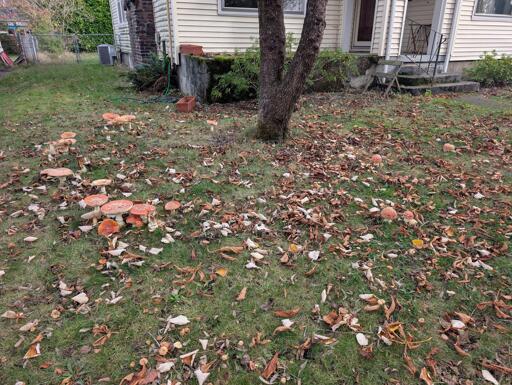
Yeah, it seems to be a name used for multiple species within the Laccaria genus. It might be like a metonym where one species name became the name for related species even if the trait that inspired the name isn’t shared by all related species.
Multiple sources seem to indicate that it’s called the deceiver because its appearance is variable (cap shape, color, et al.), so it can be difficult to identify depending on which variation it presents.

I prefer writing short stories because it prevents you from wasting a lot of time with possibly interesting but ultimately superfluous world-building details. There’s a balance to be struck between keeping the story moving and describing enough to let the reader’s imagination take over and fill in their own details, even subconsciously.
I’ve taken to starting stories in media res more often because it keeps the attention long enough to build curiosity and drop in the details as you go along.
The older I get, the more I find I lose patience reading novels that spend too long with excess dialogue that ultimately doesn’t drive the plot anywhere, serving as unfulfilled promises or red herrings at best.
Even some otherwise good writers will let you get halfway or more through a novel before you understand where the plot is going. I wonder how much some novelists add primarily due to expectations for longer word counts, the way broadcast TV shows were constrained by half hour or hour long slots with commercial breaks and that dictated the flow.



That one depends on the job. Some managers will love to exploit your inclination to hyper focus on solving problems and following the rules. They won’t ask you to work unpaid after hours but if you want to they won’t protest… Doing a third of the work for a team of six people? That’s great, but your next performance review will include the criticism that you’re not as social as your coworkers because you’re too busy doing the job.

The fragments can be a stylistic choice. Ultimately all writing “rules” are arbitrary and often decided by consensus, often based on “what we’ve always done” as much as based on a specific reason for better communication or possibly a reason that is moot now. It’s good to know what your potential readers are likely to prefer and it’s good to know what an editor or agent will want if you’re hoping to get published in a traditional manner.
That being said, I’m a fan of breaking “rules” when you have a good reason to and know why you’re doing it. If the narrative is reflecting the fragmented thoughts of a character, fragments might thematically work really well.
That said there are also ways of rephrasing the fragments to make them flow better. Some readers might find them abrupt because they’re looking for the noun and the verb with some kind of active action.
For the heavy chain, some readers won’t think of it as a grade or gauge of chains. Sometimes technically accurate isn’t better than stylistically smooth. But it isn’t a significant difference, so definitely keep it if you like it. You should write for yourself first of all.
I liked it in general. It was an interesting glimpse into a world where there are implications of greater detail I’d be curious to know more about, such as how the main character’s age and knowledge of magic works. Some of the characters are necessarily one dimensional in such a short peic of writing. Scared and concerned victims of witch trials and puritanical patriarchal male authoritarians is what I’d expect because that’s what’s been depicted before, in the Crucible, in the Sleepy Hollow movie, and other fictional depictions.
If you share a Google doc link instead of a PDF, people can make comments in the document itself, so it’s easier to provide direct feedback to specific text.
You have some tense issues. “Behind him, sat a woman.” (past tense) then “…she stares down…” (present tense).
Some of the sentences are incomplete sentences. “Her posture, in direct contrast to that of the Good Reverend.”
“A red mark wraps around her neck, and a heavy chains secure her delicate wrists.” Wraps is odd as an active verb unless the mark is appearing in the moment. Usually an inanimate thing is wrapped around rather than wraps. I’d suggest something like “stretches around.” “Heavy” is redundant with chains. Chains are rarely light. “a heavy chains” has an agreement problem. A is singular, chains is plural.
“and the Reverend’s clearly dire distress,” It hasn’t seemed like he’s in dire distress prior to this descriptor. Earlier he was described as having a “posture proud with authority…” “full of fire and fury, but steady and deliberate.”
Some of the narration seems to be Colette’s internal monologue and should probably be in italics to distinguish it from just third person omniscient narration.
For example: “This poor girl has not a speck of magic in her – And the vegetables from Reinette’s garden aside, neither does anyone else within a thousand kilometers.”
But then the next paragraph mentions Colette in the third person again.
There are too many to mention since there’s so much out there.
You can go to a font website like dafont and perform a search for a font or browse different themes/styles and specify in the results that you want Public domain / GPL / OFL fonts.
Almost all of my fonts are released under an attribution license, so they’re free for commercial use and remixing.

I feel like you’d need to be specific about what kind of pirate existed in the late 19th century. It’s not the stereotype of the Caribbean pirate from the Golden Age. There were regional pirates near China and India. But pirates in the west in the late 19th century were mostly suppressed. You might have a former privateer from the Civil War still alive in the 1890s and he might be in his mid 40s at the youngest.
A pattern I’ve noticed isn’t the legal aspect, but rather the monetization. Everyone is offering a platform where an obscure writer can pay to give away their writing for free or pay for an ad campaign where you’re spending more on ads than you will otherwise make off your work. One of the significant advantages for writing is that it requires very little overhead versus another activity like making physical objects that require equipment and material. But the market is saturated and publishing platforms are harder to access unless you’re a guaranteed seller who is already somewhat famous or has a built-in following. And there’s always someone out there willing to “help” by taking your money for the promise of connections and exposure.
It reminds me of the old poetry contest scams where you submit a poem, they tell every poet that they’ve “won” and will be published, and then they offer a “discount” for poets published in the book to get print copies for you and your friends and family, but the book is only advertised to the poets.
It does seem like there should be more open and free resources for this—websites where authors and readers connect without barriers or monetization. There probably are, but they don’t show up high in search results. Obviously they’re not going to be seen before all the paid options with ad funding.
The print instructions mention sticker paper as an option. There are some types of sticker paper that work fine on inkjet printers. Then you could just stick it down on pieces of wood or something like that. If you have access to a vinyl cutter like a Cricut or Silhouette machine, you could cut them out more easily.
The license is Creative Commons Attribution - Non Commercial 2.5 Mexico, which allows for remixing. It could be cool to make a 3D printed version of the board and pieces.

About 18 years ago when I was a dispatcher, I had someone call 911 to report their drug dealer stole their laptop because they couldn’t afford to pay for the drugs they wanted to purchase. I asked them a few times if they would like to file a police report that states that they intentionally purchased illegal drugs. They didn’t seem to understand the angle of the question and we asked them to stay where they were so a deputy could go out and take a statement.














Or Linda Hamilton’s in Terminator 2, except literally.