
Hey! I do this by setting my freezer temp to the lowest possible when my panels produce excess electricity. Then back to normal for the night, the 6C difference is enough to not use additional power until the sun comes up again.
One day I will automate this… one day
How the heck would you automate it? Wiring directly to the buttons in the freezer? I don’t have solar yet but it’s an interesting idea to remember
The fridge has wifi and an app for all those times when you’re on the road and feel the urge to change your fridge/freezer settings. I haven’t used it yet and am hesitant to let it go online. But I’m hoping I can still connect the fridge to my wifi locally and control it that way. From there I hope If (sunny) (set freezer to -24C) ELSE (set freezer to -18C) will work.
Ahh I forgot about wifi. Yeah I’d be hesitant, too. Did you check the home assistant site to see if someone’s done it before?
Had a quick look and it seems to be easy if I take the fridge online, that would be a deal breaker so will need to do some digging about just keeping it connected locally
There are industrial-scale versions of this already. Not as a solution for excess solar power storage, but to take advantage of off-peak electricity costs.
Which is not too far off, I would say. Not to say the same, since prices probably follow peak production of solar energy. 🤔
Generally, off-peak prices are about demand rather than supply. They are lowest at night due to the lowest demand being at night, while supply (from e.g. nuclear) remains constant.
Even as a former floridian this idea strikes me as dumb - although in full transparency I can’t put my finger on why lol
We have heat pumps and other such refrigeration methods to what he is doing (but in reverse). Hes just making a novel one using ice to be honest.
Its jank but interesting from a tech perspective.
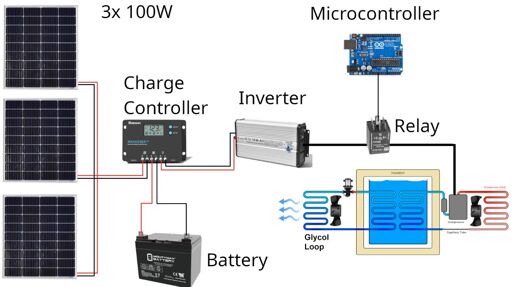
Yeah I get what he is doing it just feels wonky - assuming you already have enough panels to charge your batteries overnight -and- run a/c during the day, this design is advantageous how? Instead of using the infrastructure you already own (batteries + a/c) you need to build a large water freezing receptical and machinery to do the freezing and an electric fan system to bring warm air from the home over/around the radiator attached to the ice? It seems less tech and more redneck swamp cooler with more bits to me, I dunno.
I think youre misunderstanding one thing, which is that the ice is a replacement for batteries. While the system had a small battery for running a small pump and fan, its a small cheap one that doesn’t store much and the water has substantially more energy, equivalent to something like a large lithium battery.
The thermal battery is also far smaller, cheaper, and more robust than a lithium battery and it won’t deteriorate with repeated cycling. The obvious trade off is that in this case it can only be used for refrigeration and only down to 0C. So while its very niche, it is quite effective for home air conditioning.
I think youre misunderstanding one thing, which is that the ice is a replacement for batteries.
No, I understood that.
The thermal battery is also far smaller, cheaper, and more robust than a lithium battery and it won’t deteriorate with repeated cycling.
The repeated cycling thing is the only advantage I see to this, the ice block will not be smaller than a normal battery array.
So while its very niche, it is quite effective for home air conditioning.
Is it?
Is it?
92kWh/m^3 of energy is a lot of cooling. It’d be hard to not be effective.
These one ton blocks of ice would provide 12,000 Btu/h of cooling for 24hours.
So a block of ice about the size and weight of a car to cool one house… I’m really just not following how any of this is worthy of attention?
size and weight of a car
blocks of ice measuring 4 ft × 4 ft × 2 ft.
This you?

Because 32 cubic ft is about the volume of most residential AC units.
He goes into the storage being theoretically better with water vs batteries as a possible advantage.
But if I were serous about solar and air conditioning, I would go with a solar powered mini split. Ive heard good things about them and they seem to work.
I installed a minisplit in my RV and it is partially powered by solar when I am off grid. Works very well!
Ha nice!